Why Regional Style Is the Foundation of Ballet Folklorico
In ballet folklorico, every dance number is tied to a specific Mexican state — and the Mexican folkloric dress by region is not interchangeable. The attire from Jalisco tells a different story than the dress from Veracruz or Michoacan. Each carries distinct colors, silhouettes, fabric traditions, and cultural significance that experienced audiences, teachers, and judges recognize on sight. Mi Lindo Folklor, based in San Diego, California, specializes in authentic regional folkloric attire for dancers, school programs, and performance groups throughout the United States. This guide breaks down the three most commonly performed regional styles in California — Jalisco, Veracruz, and Michoacan — and covers what to look for when choosing the right dress for your choreography.
The Jalisco Style: Mexico’s Most Recognized Regional Attire
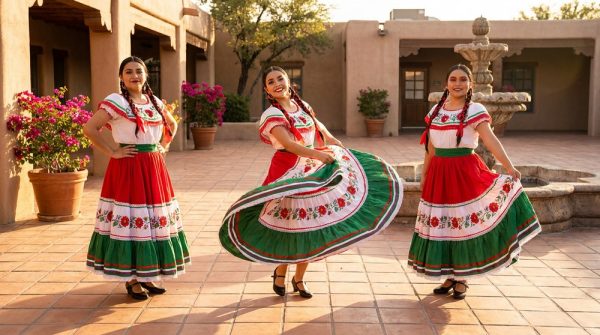
The Jalisco dress is the most recognized piece of folkloric attire in the world. Its defining feature is a wide, tiered skirt — typically red, white, and green — loaded with enough fabric to support the dramatic spins of the jarabe tapatío, Mexico’s national dance since 1924. The skirt must have the weight and structure to complete a full 360-degree revolution and return to natural drape on its own. A dress that does not spin correctly is immediately noticeable to anyone who has seen it done right.
The blouse is typically white with embroidered trim, paired with a rebozo or ribbon sash. For California school programs, the Jalisco style is the most common starting point for good reason — it anchors a wide range of recital choreography and nothing substitutes for it when the number calls for it.
The Veracruz Style: White Cotton, Lace, and the Bamba Tradition
The Veracruz folkloric dress reflects the coastal character of this Gulf state — lighter fabrics, white cotton or eyelet, lace trim, and a feminine silhouette that differs sharply from the heavy, wide Jalisco skirt. The Veracruz dancer typically carries an abanico (fan) in choreography and wears flowers or a headpiece rather than a rebozo. The movement vocabulary of Veracruz numbers — including the famous La Bamba — requires a dress that moves freely and does not restrict the legs. A Jalisco skirt would lock down the footwork that makes Veracruz choreography distinctive.
Veracruz attire is the second most commonly performed regional style in California programs, particularly at the junior high and high school level. The white-on-white aesthetic is striking under stage lighting. Adding a Veracruz number to your program means buying a separate garment — these are not variations of the same dress.
Michoacan: The Dress of the Purépecha People
The Michoacan dance costume is immediately recognizable through its black and pink — the colors of the Purépecha tradition from the lake region of Michoacan state. The dress features a black saya (a skirt-apron) over a contrasting underlayer with Purépecha embroidery on the blouse. The silhouette is structured and less voluminous than the Jalisco style, suited to Michoacan choreography. The Danza de los Viejitos is the most widely performed Michoacan piece in school programs, and the right dress is part of what makes the number legible to an audience.
A common mistake is purchasing a generic black-and-pink dress and calling it Michoacan attire. The specific embroidery patterns and construction are what separate authentic regional dress from a visual approximation — and Mi Lindo Folklor’s Michoacan selection is sourced for that accuracy.
Beyond the Big Three: Sinaloa, Oaxaca, and Other Regional Styles
Jalisco, Veracruz, and Michoacan are the most widely performed styles, but California programs increasingly include choreography from other states. The Sinaloa folkloric dress brings layered ruffles and tropical color from Mexico’s Pacific coast. Oaxacan dress introduces bold geometric embroidery from Zapotec and Mixtec traditions. Guerrero and Chihuahua each have distinctive attire tied to specific dances their communities have performed for generations.
As a program expands beyond standard Jalisco and Veracruz numbers, understanding regional differences determines whether what you buy is right for the performance or just close enough to pass at a distance.
How to Know Which Regional Dress Your Performance Requires
Ask your choreographer or dance director before buying anything. Most teachers specify the required Mexican folkloric dress by region when they assign a number. If you only receive a piece title, use the state of origin to determine the correct dress. The pairings below cover the most common cases for California school programs.
- Jarabe Tapatío / La Negra: Jalisco dress required — wide tiered skirt, red/white/green
- La Bamba: Veracruz style — white cotton, lace trim, fan accessory
- Danza de los Viejitos: Michoacan regional dress — black saya, Purépecha embroidery
- El Sinaloense: Sinaloa dress — layered ruffles, tropical color palette
When buying for a group, confirm the exact color palette with the director. Small variations between garments from different suppliers are visible on stage under uniform lighting. Browse Mi Lindo Folklor’s collection by region to find the right folkloric dance attire for your choreography.
Can One Dress Serve Multiple Regions?
No. A wide Jalisco skirt cannot stand in for a Veracruz dress any more than a mariachi suit can stand in for a traje de charro. The garments are built for different movement patterns, carry different cultural meanings, and are fundamentally different in construction.
For school programs building inventory, start with the Jalisco style — the most versatile for standard recital choreography — then add regional-specific pieces as the repertoire grows. Mi Lindo Folklor can help match your program list to the correct attire for each number.
Frequently Asked Questions About Regional Folkloric Dress
Can I use a Jalisco dress for Veracruz choreography?
No. The Jalisco style has a heavy skirt built for spinning, while Veracruz numbers require a lighter dress that allows leg movement and footwork visibility. The movement will be physically restricted by the wrong garment, and in competition the wrong regional dress results in presentation deductions.
Is the Mexican folkloric dress by region always different, or do some styles overlap?
Regional styles are distinct in construction and cultural origin, though neighboring states sometimes share fabric choices or base color palettes. Skirt weight, blouse style, and required accessories are what truly separate one regional dress from another. When in doubt, contact Mi Lindo Folklor — getting the regional details right matters more than it might seem from a distance.
How do I find the right Michoacan dress if I have never bought one before?
Focus on the defining elements: black and pink, a structured saya silhouette, and Purépecha-style embroidery on the blouse. Be cautious of generic “black and pink Mexican dress” listings on large retail platforms — these are approximations with no connection to Michoacan tradition. Mi Lindo Folklor’s Michoacan selection is sourced for regional accuracy, not just color match.
Does Mi Lindo Folklor carry attire for less common regional styles?
Yes. Beyond Jalisco, Veracruz, and Michoacan, Mi Lindo Folklor carries attire for Sinaloa and can assist with sourcing for other regions depending on availability and lead time. Contact us with your regional requirements and performance date.
Ready to Get Started?
From Jalisco to Veracruz to Michoacan and beyond, Mi Lindo Folklor carries authentic regional folkloric attire for every performance, school program, and cultural celebration.
Contact our team or call us at (619) 341-1202.